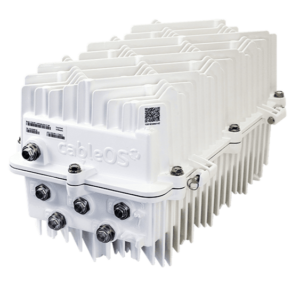
Harmonic Node Test 10 Harmonic Nodes Testing For Training Module: Harmonic Remote PHY Node Operations & Troubleshooting 1 / 30 1. What does RPD stand for? A. Remote PHY Device B. Radio Power Distribution C. Redundant PHY Deployment D. Routing Protocol Device 2 / 30 2. What is a crucial consideration when integrating Harmonic Remote PHY nodes into an existing DOCSIS network? A. Ensuring the upstream power levels are within acceptable ranges B. Assigning static IP addresses to each subscriber C. Replacing coaxial cable infrastructure with fiber-only connectivity D. Disabling remote monitoring features to prevent unauthorized access 3 / 30 3. What is a significant benefit of Distributed Access Architecture (DAA) using Harmonic R-PHY nodes? A. Eliminates the need for headend equipment B. Allows cable operators to scale networks with reduced CAPEX C. Provides native IPv6-only support D. Uses high-frequency radio waves for data transmission 4 / 30 4. Which component in the Harmonic node enables ingress noise suppression? A. Return-path mute switch B. Load balancing module C. Adaptive streaming controller D. Optical network unit (ONU) 5 / 30 5. What is the primary function of the return-path mute switch in a Harmonic Remote PHY node? A. Suppresses ingress noise B. Amplifies downstream signals C. Provides power redundancy D. Filters out RF reflections 6 / 30 6. What type of power supply options are available for Harmonic nodes? A. RF-powered or AC port B. Dynamically allocates DOCSIS service groups C. Adjusts signal levels to compensate for environmental changes D. Prevents illegal access to CMTS data 7 / 30 7. Which frequency splits are supported by the Harmonic RPN for upstream operation? A. 5-600 MHz, 10-750 MHz, 20-900 MHz B. 50-450 MHz, 500-750 MHz, 1000-1218 MHz C. 5-42 MHz, 5-85 MHz, 5-204 MHz D. 5-100 MHz, 10-200 MHz, 30-300 MHz 8 / 30 8. Which metric is most commonly used to evaluate upstream performance in a Harmonic node? A. BER (Bit Error Rate) B. Downstream MER (Modulation Error Ratio) C. Upstream SNR (Signal-to-Noise Ratio) D. Packet loss percentage 9 / 30 9. What type of power supply options are available for Harmonic nodes? A. Battery-only backup B. Solar-powered energy system C. RF-powered or AC port D. Power over Ethernet (PoE) 10 / 30 10. What is the primary role of the Pebble-1 Remote PHY Device in Harmonic nodes? A. Converts digital signals to RF for distribution B. Provides real-time QoS enforcement C. Acts as a failover power supply D. Monitors temperature and humidity levels 11 / 30 11. What is the primary function of an RF test point in a Harmonic node? A. Allows field technicians to measure signal levels B. Automatically filters out signal reflections C. Synchronizes timing with headend CMTS D. Redirects downstream video traffic to local services 12 / 30 12. What is a key advantage of using a Remote PHY node over traditional HFC nodes? A. Simplified manual configuration B. Increased MPEG-2 compression efficiency C. Lower fiber optic costs D. Reduced latency and jitter 13 / 30 13. What is a likely reason for poor MER (Modulation Error Ratio) in a Harmonic node? A. Excessive TCP/IP retransmissions B. Incorrect VLAN configuration C. Overloaded RF launch amplifier D. Use of MPEG-2 instead of MPEG-4 14 / 30 14. Which network configuration is required for a Harmonic node to function properly? A. Proper IP routing and DHCP configuration B. Static MAC address filtering C. UDP port blocking for enhanced security D. Disabling IPv6 tunneling 15 / 30 15. Which protocol does Harmonic nodes use to synchronize timing between the headend and the node? A. SNMP v3 B. IEEE-1588 PTP C. DOCSIS 3.1 DQOS D. VLAN Spanning Tree 16 / 30 16. Which feature allows Harmonic Remote PHY nodes to support different RF configurations without hardware changes? A. Remote RF tuning B. DOCSIS 3.0 adaptive modulation C. Static RF channelization D. Manual port switching 17 / 30 17. Which condition can cause a Remote PHY node to drop its RF output? A. Insufficient fiber length B. Overheating due to ventilation blockages C. Incorrect VLAN tagging D. IPv4 address exhaustion 18 / 30 18. Which segmentation options are supported by the Harmonic Shell-1 RPN? A. 1x1 and 1x2 B. 2x4 only C. Both A and B D. 2x2 and 2x3 19 / 30 19. Which condition could cause excessive signal attenuation in a Harmonic Remote PHY node? A. Overdriven optical input power B. Incorrect DOCSIS service flow configuration C. Excessive VLAN provisioning D. High CPU utilization in the headend 20 / 30 20. What is the primary function of a Harmonic Remote PHY Node (RPN)? A. Aggregating multiple DOCSIS channels at the headend B. Optical-to-electrical signal conversion C. Ensuring full-duplex transmission in DOCSIS networks D. Providing last-mile connectivity to customers 21 / 30 21. Which component in a Harmonic Remote PHY node is responsible for forward-path signal amplification? A. Adaptive load balancer B. RF launch amplifier C. Optical filter D. DOCSIS modem module 22 / 30 22. Which networking protocol does Harmonic Remote PHY use for time synchronization? A. SNMP v3 B. DOCSIS DQOS C. VLAN Trunking Protocol D. IEEE-1588 PTP 23 / 30 23. What is the function of the integrated RF launch amplifier in Harmonic RPN? A. Extending fiber connections B. Converting DOCSIS to IPTV signals C. Filtering out ingress noise D. Boosting RF signal for coaxial distribution 24 / 30 24. What is the maximum downstream bandwidth supported by the Harmonic Shell-1 RPN? A. 204 MHz B. 860 MHz C. 1218 MHz D. 2500 MHz 25 / 30 25. Which software can be used to monitor and manage Harmonic nodes remotely? A. CableOS Core B. Solarwinds C. Wireshark D. Cisco Smart PHY 26 / 30 26. What is a primary cause of upstream signal ingress in Harmonic nodes? A. Poor RF shielding in coaxial cables B. Incorrect IPv6 routing tables C. Optical fiber splicing errors D. Faulty modulation profiles 27 / 30 27. Which technology does the Harmonic RPN use for distributed access architecture (DAA)? A. Fiber Deep Technology B. Remote PHY (R-PHY) C. Dense Wavelength Division Multiplexing (DWDM) D. DOCSIS 4.0 High Split 28 / 30 28. Which software is used for remote configuration of Harmonic Remote PHY Nodes? A. Cisco Prime Network B. DOCSIS CMTS CLI C. CableOS Core D. NetMRI Monitoring Suite 29 / 30 29. What is the function of Remote PHY (R-PHY) in DOCSIS networks? A. Converts digital signals from the core to RF for last-mile delivery B. Encrypts video streams for secure transmission C. Manages CMTS routing tables D. Controls IP multicast group distribution 30 / 30 30. What is a key method of preventing power issues in Harmonic nodes? A. Use of solar panels B. Using redundant AC or RF power supplies C. Switching from DOCSIS 3.1 to DOCSIS 4.0 D. Disabling return path functionality Your score isThe average score is 91%